How to Keep Muscle on Tirzepatide and Other GLP-1 Medications
Muscle loss is the single most repeated criticism of GLP-1 weight loss, and it is also the one most often reported badly. The honest version is more nuanced than the headlines and, usefully, more actionable. Here is what the research actually shows and what you can do about it.
The short answer
You do lose some lean mass on a GLP-1, but published estimates range from roughly 15% to 60% of total weight lost, so no single scary number is settled science. Three things protect muscle: enough protein, resistance training, and measuring body composition instead of scale weight so you can see what is actually happening.
Does tirzepatide actually make you lose muscle?
Yes, partly, and that is true of essentially every method of losing a significant amount of weight. Bariatric surgery does it. Very low calorie diets do it. The body does not exclusively burn fat when it runs a deficit.
What is genuinely unsettled is how much, and this is where most articles on the subject go wrong. A 2024 review in Diabetes, Obesity and Metabolism, led by researchers at Case Western Reserve and Linköping University, looked across the published trials and found the reported figures scattered across a very wide range: in some studies lean mass accounted for 40 to 60% of total weight lost, while in others it was around 15% or less.
That is not a small disagreement. It is the difference between "half of what you lose is muscle" and "a sixth of what you lose is muscle". The review attributes the spread to differences in the populations studied, the specific drug, and how much weight was lost overall.
There is a second point in that review worth knowing, because almost nobody mentions it. "Lean mass" is not the same thing as muscle. The measurement includes organs, bone, fluid and the water held in fat tissue. When you lose a lot of weight, some of that decline is expected and not a loss of functional muscle at all. Using MRI-based measurement, the authors describe the muscle changes seen with these medications as broadly adaptive, meaning roughly what you would expect given the amount of weight lost, alongside improvements in muscle quality such as less fat infiltrating the muscle.
None of that means the concern is imaginary. The same review flags older age and more severe disease as reasons to be more careful, because of sarcopenia risk. It means the concern is manageable rather than a reason to avoid treatment.
How much muscle do you lose on a GLP-1?
There is no single honest number, and you should treat any page that gives you one with suspicion. What exists is a range, and where you land inside it is influenced by things you control.
| What gets reported | What it means in practice |
|---|---|
| 40 to 60% of weight lost as lean mass, in some studies | The figure that drives most alarming headlines. Real, but at the high end of a contested range. |
| Around 15% or less, in other studies | The same class of medication, measured in different populations with different methods. |
| "Lean mass" includes organs, bone, fluid | Part of the measured decline is not functional muscle at all. |
| MRI-based muscle assessment | Changes described as commensurate with the weight lost, with improved muscle quality. |
The practical reading of that spread: it is wide enough that your protein intake and your training sit inside it. That is a much more useful conclusion than a single percentage, because it is something you can act on this week.
How much protein should you eat on tirzepatide?
Start with what is honest: there is no GLP-1-specific protein target published by a health authority. Pages that quote you an exact number of grams as though it were an official recommendation are inventing precision that does not exist.
What the weight loss literature does support as a principle is that protein requirements go up rather than down when you are in a calorie deficit and trying to hold onto lean tissue. Protein is the raw material; a deficit is when the body is most inclined to break tissue down.
On a GLP-1 the problem is not the usual one of talking yourself out of a second helping. It is the opposite:
- Appetite suppression works against you here. The medication reduces how much you want to eat, and protein-rich foods are often the most filling ones, which makes hitting any target harder precisely when it matters most.
- Nausea reshapes what you can face eating. Early in treatment, and after each dose increase, many people drift toward bland carbohydrates because protein feels heavy.
- Smaller total intake means each meal has to work harder. If you are eating substantially less overall, the composition of what you do eat carries more weight than it did before.
This is a genuinely good use of the clinician or dietitian attached to a program, because the answer depends on your body weight, your starting point and what you can actually tolerate at your current dose. If your provider has no one to ask about this, that is worth noticing about the provider.
Does strength training prevent muscle loss on a GLP-1?
This is where the evidence gets encouragingly specific.
A 2026 systematic review and network meta-analysis in Diabetes, Obesity and Metabolism pooled 34 randomised controlled trials covering 1,455 people with overweight or obesity, comparing calorie restriction alone against calorie restriction plus exercise. The headline result: adding exercise prevented nearly half of the fat-free mass loss, 45.7%.
Broken down by type of training, the network analysis found:
- Mixed training (combining strength and endurance) produced the largest effect, +1.20 kg of fat-free mass preserved
- Strength training came next, +0.83 kg
- Endurance training alone fell just short of statistical significance
An important caveat, stated plainly: those were calorie restriction trials, not GLP-1 trials. They describe the same physiological situation, losing weight in a deficit, but they were not testing people on this medication. That is a reasonable extrapolation rather than a direct finding, and we would rather label it than let it pass as something it is not.
Can you build muscle while on tirzepatide?
Building meaningful new muscle while in a real calorie deficit is hard. A 2022 meta-analysis in the Scandinavian Journal of Medicine & Science in Sports found that energy deficiency impairs the lean mass gains you would normally get from resistance training.
But the same analysis found something that reframes the whole question: the deficit impaired lean mass gains but not strength gains. You can realistically get stronger while losing weight, even if you are not adding visible size. And for protecting what you already have, the training is doing its job regardless.
Why the bathroom scale is the wrong tool for this
Everything above has a practical problem attached: you cannot tell which of it is happening to you.
A scale reports a single number, total mass. It cannot separate fat from muscle from bone from water. Nine pounds down looks exactly the same on the display whether those nine pounds were almost entirely fat or whether a meaningful share was lean tissue.
On most weight loss approaches you get a crude second signal, because progress stalls and forces you to pay attention. A GLP-1 removes even that. The number falls reliably, which is the point of the medication, and the reliability is precisely what hides the composition question underneath it.
So if muscle is the thing you are worried about, the fix is not to worry harder. It is to measure the right variable:
- Body composition measurement splits the number into fat and lean mass, which is the only way to see the trend that actually concerns you
- Strength benchmarks are a free proxy. Pick two or three movements, record what you can do now, and retest monthly. Losing strength on a lift you could previously handle comfortably is a signal worth raising with a clinician
- Trends beat single readings. Any one measurement is noisy, whatever the method. A direction over three months tells you far more than a number today
The gap this exposes is a real one, and it is why some telehealth providers have started building measurement into the program rather than leaving it as your homework.
A GLP-1 program that measures this by default
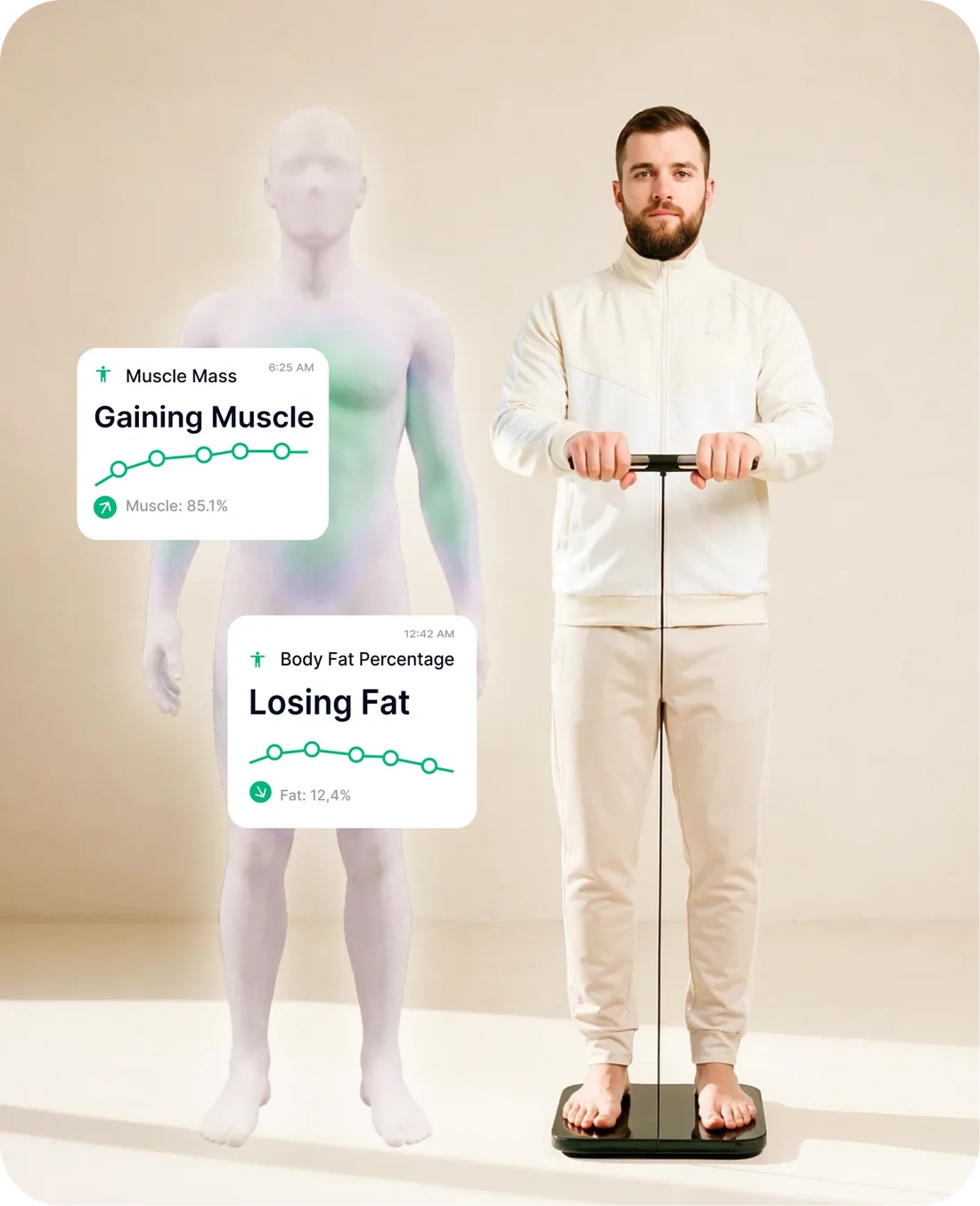
Most GLP-1 telehealth services sell a prescription and an app, and hand you a scale number. HumeCare+ builds 3D body composition scanning into the plan, tracking lean mass separately from fat, and includes glycine, B12 and B6 in the protocol for the same stated reason. We looked at how it works, what it costs and what its money-back promise actually covers.
Read the full HumeCare+ reviewThe practical checklist
If you are on a GLP-1 or about to start one, and muscle is your concern, this is the short version of everything above:
- Make protein the priority at every meal, and plan it in advance, because appetite suppression means you will not feel prompted to. Agree a target with a clinician rather than copying a number off a website.
- Do resistance training at least twice a week, and combine it with some cardio if you can, since mixed training showed the largest preservation effect in the meta-analysis.
- Measure body composition, not just weight, whether that is through a program that includes it or by getting scanned independently.
- Keep two or three strength benchmarks and retest monthly. Free, immediate, and it catches functional decline that a number on a scale will not show.
- Do not rush the loss if you have a choice about the pace. Faster is not automatically better here.
- Raise a genuine strength drop with your clinician rather than waiting to see if it settles. That is what the clinical support is for.
This article is general information, not medical advice, and none of it is a substitute for the clinician managing your treatment. Do not start, stop or change a prescription medication based on something you read online.
Frequently asked questions
Does tirzepatide make you lose muscle?
Some lean mass is lost alongside fat during any substantial weight loss, and that includes weight loss on tirzepatide. What is genuinely contested is how much. A 2024 review in Diabetes, Obesity and Metabolism found the reported figures range widely, from 40 to 60% of total weight lost in some studies down to around 15% or less in others, and noted that lean mass measurements include organs, bone and fluid, not just muscle. So yes, you lose some, but the alarming end of the range is not a settled finding.
How much muscle do you lose on a GLP-1?
There is no single number, and any article giving you one is oversimplifying. Published trials report lean mass accounting for anywhere between roughly 15% and 60% of total weight lost, depending on the population studied, the medication, the measurement method and how much weight was lost overall. The more useful takeaway is that the range is wide enough that your own behaviour, protein intake and resistance training in particular, sits inside it.
How much protein should you eat on tirzepatide?
There is no GLP-1-specific protein guideline from a health authority, so be sceptical of pages quoting a precise number as though there were. The general principle from weight loss research is that protein needs go up rather than down when you are in a calorie deficit and trying to hold onto lean mass. The practical problem on a GLP-1 is different from the usual one: appetite suppression makes hitting any protein target harder, so this is worth planning with the clinician or dietitian attached to your program rather than guessing.
Does strength training prevent muscle loss on a GLP-1?
Exercise during calorie restriction substantially reduces how much fat-free mass you lose. A 2026 meta-analysis of 34 randomised controlled trials covering 1,455 people found that adding exercise to calorie restriction prevented nearly half of the fat-free mass loss, 45.7%, compared with dieting alone. Mixed training produced the largest effect and strength training was the next best. Those trials were not specifically GLP-1 studies, but they describe the same physiological situation: losing weight in a calorie deficit.
Can you build muscle while on tirzepatide?
Building substantial new muscle while in a meaningful calorie deficit is difficult for most people. A 2022 meta-analysis found that energy deficiency impairs the lean mass gains from resistance training, but importantly, it did not impair strength gains. That distinction matters: you can realistically expect to get stronger while losing weight even if the scale-visible muscle gain is limited, and training still does the job of protecting what you already have.
Why can't a bathroom scale tell you if you're losing muscle?
A scale reports one number: total mass. It cannot separate fat from muscle, bone or water, so a falling number looks identical whether the loss is mostly fat or partly muscle. This is why body composition measurement matters more on a GLP-1 than on almost any other weight loss approach: the medication makes the number fall reliably, which removes the feedback you would otherwise get from a stall.
What are the warning signs you are losing too much muscle?
Practical signals worth raising with your clinician include losing strength on movements you could previously do comfortably, unusual fatigue that does not settle, feeling weaker climbing stairs or carrying shopping, and rapid weight loss without any resistance training or protein attention. None of these confirm muscle loss on their own, which is exactly why measurement beats guesswork, but a clear drop in day-to-day strength is worth a conversation rather than a wait-and-see.
Do GLP-1 programs that include body composition scans help with this?
They change what you can see rather than what the medication does. A program that scans body composition tells you the split between fat and lean mass over time, so if lean mass is trending down you can adjust protein and training while there is still time to act. Some telehealth providers include this in the plan. HumeCare+ is the one we have reviewed that builds 3D body composition scanning into the program rather than leaving it to you.
Related reading
Sources
- Neeland IJ, Linge J, Birkenfeld AL. Changes in lean body mass with glucagon-like peptide-1-based therapies and mitigation strategies. Diabetes Obes Metab. 2024 Sep;26 Suppl 4:16-27. PMID: 38937282.
- Deller M, Weiershaus J, Held S, Brinkmann C. Effects of Calorie Restriction With and Without Strength, Endurance or Mixed Training on Fat-Free and Skeletal Muscle Mass in Overweight or Obese Individuals: A Systematic Review With Pairwise Meta-Analysis and Network Meta-Analysis of Randomized Controlled Studies. Diabetes Obes Metab. 2026 Aug;28(8):6810-6823. PMID: 42144246.
- Murphy C, Koehler K. Energy deficiency impairs resistance training gains in lean mass but not strength: A meta-analysis and meta-regression. Scand J Med Sci Sports. 2022 Jan;32(1):125-137. PMID: 34623696.
Disclosure: this article links to our review of HumeCare+, which contains an affiliate link. If you sign up through it we may earn a commission at no extra cost to you. That does not change what the research above says. See our Editorial Policy.